Supplements
Creatine Loading Phase: Is It Really Necessary?
A creatine loading phase is the fastest way to raise muscle creatine stores, but it is not required.
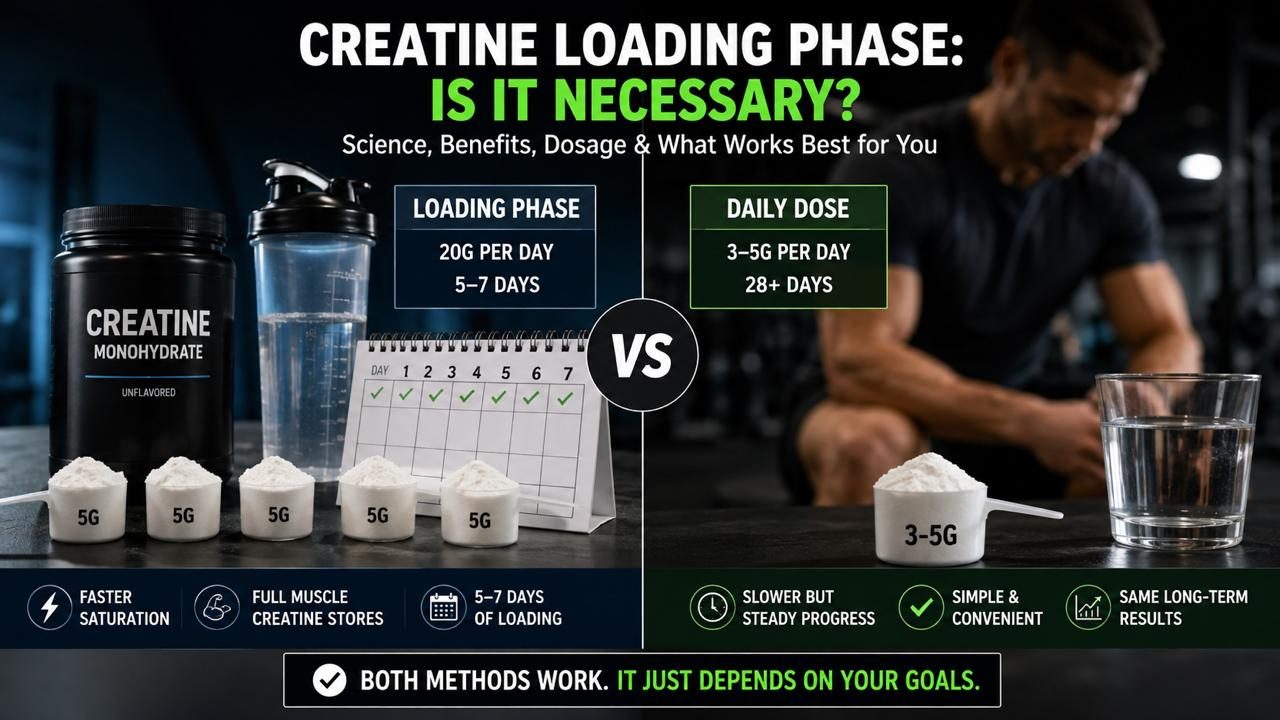
Creatine Loading Phase: Is It Really Necessary?
Quick Summary
A creatine loading phase is the fastest way to raise muscle creatine stores, but it is not required.
The standard approach is:
- Take about 20 grams daily
- Divide it into four 5-gram servings
- Continue for five to seven days
- Then take 3–5 grams daily for maintenance
Skipping loading and taking 3–5 grams every day can produce similar long-term muscle saturation. It simply takes approximately three to four weeks instead of about one week.
Loading is most useful when someone wants faster saturation. A gradual daily approach is simpler and may cause less digestive discomfort.
Creatine Loading Phase at a Glance
| Question | Practical answer |
|---|---|
| Is loading required? | No |
| Typical loading dose | 20 g daily in four servings |
| Loading duration | 5–7 days |
| Maintenance afterward | 3–5 g daily |
| Time to saturation with loading | About one week |
| Time without loading | About 3–4 weeks |
Introduction
A creatine loading phase is a short period of higher-dose supplementation designed to saturate your muscles more quickly.
The traditional protocol uses approximately 20 grams of creatine monohydrate per day for five to seven days. That amount is divided into several smaller servings rather than taken all at once.
After loading, intake drops to a maintenance dose of 3–5 grams per day.
The main advantage is speed. Loading can substantially increase muscle creatine stores within about one week, while a standard 3–5-gram daily routine generally takes three to four weeks to reach similar saturation.
However, loading does not create a higher permanent ceiling for muscle creatine storage. Once both approaches achieve saturation, their long-term destination is broadly similar.
That means loading is optional rather than essential.
This guide explains how the protocol works, who may benefit from it, how to reduce digestive discomfort and whether a gradual approach may be better for your routine.
What Is a Creatine Loading Phase?
A creatine loading phase temporarily uses a higher daily dose to increase muscle creatine stores as quickly as practical.
The most common research-based protocol is:
- Take approximately 20 grams of creatine monohydrate per day.
- Divide that amount into four 5-gram servings.
- Continue for five to seven days.
- Switch to a maintenance dose of 3–5 grams daily.
A body-weight protocol may use approximately 0.3 grams per kilogram of body weight per day during loading.
For a 70-kilogram—or roughly 154-pound—adult, that equals about 21 grams daily.
Dividing the total dose is important. Larger single servings are more likely to cause gastrointestinal discomfort than smaller divided doses.
Best Practice: Divide a loading dose across the day instead of taking 20 grams in one serving.
Is a Creatine Loading Phase Necessary?
No. You do not need a loading phase for creatine to work.
Taking 3–5 grams of creatine monohydrate every day can eventually raise muscle creatine stores to a similar level.
The primary difference is how quickly that happens.
| Protocol | Typical daily intake | Approximate time to saturation |
|---|---|---|
| Loading approach | 20 g for 5–7 days | About one week |
| Gradual approach | 3–5 g daily | About 3–4 weeks |
Loading accelerates saturation. It does not appear to provide a unique long-term benefit once both approaches have reached similarly elevated muscle creatine stores.
For many recreational exercisers, waiting several extra weeks makes little practical difference.
The gradual approach may be preferable when you:
- Want the simplest routine
- Are sensitive to stomach discomfort
- Do not need rapid performance changes
- Prefer to avoid an early jump in scale weight
- Have no competition or demanding training block approaching
Bottom Line: Loading changes the speed of saturation, not the basic long-term purpose of supplementation.
What Are the Benefits of Loading Creatine?
The main benefit of loading is reaching elevated muscle creatine stores sooner.
That can allow creatine’s performance effects to begin earlier, especially during activities that depend heavily on rapid ATP regeneration.
Potential advantages include:
- Faster muscle saturation
- Earlier support for repeated high-intensity performance
- A quicker transition to maintenance dosing
- A structured starting protocol
- Potential usefulness before a demanding training block
Loading may be practical for an athlete beginning creatine shortly before:
- A strength-training cycle
- A sprint-focused training block
- A team-sport preseason
- Repeated high-intensity testing
- A competition in which body-weight gain is not a concern
However, loading does not guarantee an immediate visible change in muscle size or a dramatic increase in strength.
Creatine supports training capacity. The training program still creates the adaptation.
For a broader explanation of what creatine can realistically improve, read Creatine Benefits: What Science Really Says.
What Are the Disadvantages of a Loading Phase?
Loading is effective, but it is less convenient than taking one small daily serving.
The main disadvantages are:
- Four daily servings to remember
- Greater chance of digestive discomfort
- Faster water-weight gain
- More creatine consumed during the first week
- No unique long-term advantage over gradual dosing
Temporary scale-weight gain is common because creatine increases water stored inside muscle.
That is not body-fat gain. Still, it may matter to athletes who compete in weight classes or endurance events where carrying additional mass could be undesirable.
Digestive symptoms are also more likely when large servings are consumed together.
Possible symptoms include:
- Nausea
- Loose stools
- Bloating
- Abdominal discomfort
- Diarrhea
These effects can often be reduced by dividing the dose, taking it with meals and avoiding the entire daily amount at once.
For a complete safety discussion, read Creatine Side Effects: What Science Really Says.
Who Should Consider a Creatine Loading Phase?
A loading phase is most useful for people who want to increase muscle creatine stores as quickly as possible.
You may consider loading if you are:
- Starting a new strength or power program
- Entering a high-intensity training block
- Preparing for repeated-sprint testing
- Beginning preseason training for a team sport
- Hoping to experience creatine’s performance effects sooner
- Comfortable managing several servings per day
Loading may also make sense when you have only a few weeks before an important event.
However, it is not necessary for recreational lifters who are willing to take creatine consistently and wait several weeks for full saturation.
The gradual approach is often better for people who value simplicity or experience digestive discomfort with larger amounts.
Practical Rule: Choose loading for speed. Choose 3–5 grams daily for simplicity.
Who May Prefer to Skip Loading?
Skipping the loading phase is a reasonable choice for most people.
A gradual daily protocol may be more practical if you:
- Have a sensitive stomach
- Prefer taking only one serving per day
- Want to minimize rapid scale-weight changes
- Are not preparing for an upcoming competition
- Find multi-dose routines difficult to follow
- Have no reason to rush muscle saturation
Taking 3–5 grams of creatine monohydrate daily can still produce similar long-term muscle creatine levels.
The difference is mainly patience.
Without loading, your muscles generally need around three to four weeks to reach levels similar to those achieved after a traditional five-to-seven-day loading phase. oai_citation:0‡PubMed Central (PMC)
There is no penalty for choosing the slower approach.
You do not lose long-term benefits simply because you skipped loading.
How to Do a Creatine Loading Phase Correctly
A simple loading schedule divides the daily amount into four servings.
Example Loading Schedule
| Time | Creatine serving |
|---|---|
| Breakfast | 5 g |
| Lunch | 5 g |
| Afternoon | 5 g |
| Dinner | 5 g |
Continue this schedule for five to seven days.
Afterward, switch to:
3–5 grams once daily
You do not need to take each serving at an exact clock time.
Spacing the servings throughout the day is mainly intended to improve digestive tolerance.
Taking 10 grams or more in one serving may increase the risk of diarrhea compared with smaller divided doses. oai_citation:1‡PubMed
Practical Tips
- Use plain creatine monohydrate
- Measure servings accurately
- Take doses with meals if your stomach is sensitive
- Mix the powder thoroughly
- Continue normal hydration habits
- Do not extend high-dose loading unnecessarily
Important: Taking more than the recommended loading amount does not mean faster or better long-term results.
Should You Take Creatine With Food During Loading?
Creatine can be taken with water, a meal or a protein shake.
Taking it with food may help because:
- It can reduce stomach discomfort
- Meals provide a reliable reminder
- Carbohydrates and protein stimulate insulin
- The powder may be easier to tolerate when not taken on an empty stomach
However, you do not need a high-sugar drink.
Creatine monohydrate works without large amounts of carbohydrates, and the added calories may not fit everyone’s nutrition goals.
A normal mixed meal is sufficient.
For example, you could take each loading serving with breakfast, lunch, an afternoon snack and dinner.
This approach makes the schedule easier to remember and avoids consuming all 20 grams at once.
What Happens After the Loading Phase?
After five to seven days, reduce your intake to a maintenance dose.
For most adults, that means:
3–5 grams of creatine monohydrate per day
Continue taking it every day, including rest days.
The maintenance dose helps keep muscle creatine stores elevated after loading.
You do not need another loading phase every few weeks.
You also do not need to cycle off creatine simply because the first loading period ended.
If you stop supplementation completely, muscle creatine stores gradually return toward baseline over several weeks.
If you later restart after a long break, you can either:
- Use another short loading phase
- Resume 3–5 grams daily and allow saturation to occur gradually
Both options are valid.
For guidance on daily use and timing, read How to Take Creatine: Dosage, Timing & Best Practices.
Can You Extend the Loading Phase?
There is usually no reason to continue taking 20 grams per day beyond the standard loading period.
Once muscle creatine stores are substantially elevated, additional high doses provide little practical advantage.
Extending loading may:
- Waste more product
- Increase digestive discomfort
- Cause additional temporary water-weight gain
- Make adherence more difficult
After five to seven days, maintenance dosing is generally sufficient.
Some research protocols use different amounts or durations, but those approaches are designed for specific studies and should not automatically be copied by the general public.
Bottom Line: A loading phase is short by design. Higher dosing is not intended to become your permanent routine.
Can You Stop Loading Early?
Yes.
If you begin a loading phase and decide that it is inconvenient or uncomfortable, you can stop and switch to 3–5 grams daily.
You do not need to restart from the beginning.
Any creatine already stored in your muscles still contributes to the saturation process.
For example, if you complete three days of loading and then move to a maintenance dose, your muscles may reach full saturation sooner than they would with a gradual protocol from day one.
The exact timeline is not important for most users.
The key is continuing with a consistent daily dose.
Does Loading Cause Faster Muscle Growth?
Loading can raise muscle creatine stores faster, but it does not directly build substantial muscle within one week.
Early changes may include:
- A small increase in body weight
- Fuller-looking muscles
- Better performance during repeated high-intensity efforts
The early increase in body weight is largely related to water stored inside muscle cells.
Actual muscle growth requires:
- Progressive resistance training
- Adequate protein
- Sufficient calories
- Recovery
- Time
Loading may allow creatine-supported training benefits to begin sooner, but it does not replace the biological process of hypertrophy.
Important: Faster saturation is not the same as instant muscle growth.
Does Loading Improve Strength Immediately?
Some people may notice improved repeated-effort performance after muscle creatine stores rise.
This can include:
- Maintaining power during later sets
- Completing an additional repetition
- Recovering energy more effectively between intense efforts
- Producing more consistent sprint performance
The effect is not guaranteed to feel dramatic.
Creatine is not a stimulant, and it does not produce the immediate sensation associated with caffeine or pre-workout products.
Its value comes from supporting the phosphocreatine energy system during repeated short, intense activity.
Any long-term strength gains still depend on consistent training.
What If You Miss a Loading Dose?
Missing one serving is not a major problem.
Do not take several servings together to compensate.
Instead:
- Continue with your next planned dose
- Keep servings divided
- Complete the remaining loading days
- Switch to maintenance afterward
A missed serving may slightly slow saturation, but it will not ruin the protocol.
The same principle applies if you miss an entire day.
Resume the schedule without doubling the next day’s intake.
Avoiding large catch-up doses is more important than following the plan perfectly.
Did You Know?
The earliest widely used creatine protocols showed that both high-dose loading and lower daily dosing could raise muscle creatine stores.
The major difference was speed: loading achieved substantial saturation within days, while smaller daily doses required several weeks. oai_citation:2‡PubMed Central (PMC)
Myths vs. Facts
Myth
A creatine loading phase is mandatory.
Fact
Taking 3–5 grams daily without loading can eventually produce similar muscle creatine saturation.
Myth
You should take 20 grams in one serving.
Fact
Dividing the daily amount into smaller servings reduces the likelihood of gastrointestinal discomfort.
Myth
Loading creates better long-term results.
Fact
Its main advantage is faster saturation, not a higher permanent level of muscle creatine.
Myth
Loading immediately builds new muscle.
Fact
Early weight gain mainly reflects additional water inside muscle cells. Muscle growth still requires training and time.
Myth
You must repeat loading every month.
Fact
A maintenance dose is generally enough to keep muscle creatine stores elevated.
Myth
Stopping loading early wastes the entire protocol.
Fact
You can switch to 3–5 grams daily at any time and continue progressing toward saturation.
Key Takeaways
- A creatine loading phase is optional.
- The standard loading protocol uses about 20 grams daily for five to seven days.
- Divide the daily amount into four smaller servings.
- Loading raises muscle creatine stores faster than taking 3–5 grams daily.
- Both approaches can reach similar long-term saturation.
- Larger single servings are more likely to cause digestive discomfort.
- After loading, switch to a maintenance dose of 3–5 grams daily.
Conclusion
A creatine loading phase is an effective way to increase muscle creatine stores quickly, but it is not required.
The traditional protocol uses approximately 20 grams per day, divided into four smaller servings, for five to seven days. After that, a maintenance dose of 3–5 grams daily helps keep stores elevated.
Loading may be useful when you want faster saturation before a demanding training period. For most recreational exercisers, however, taking 3–5 grams every day is simpler and can produce similar long-term results.
The best choice depends on your timeline, digestive tolerance and ability to follow the routine.
For a complete overview of daily dosing and long-term use, continue with How to Take Creatine: Dosage, Timing & Best Practices.
Continue Learning
- What Is Creatine? A Complete Beginner’s Guide
- How to Take Creatine: Dosage, Timing & Best Practices
- Creatine Benefits: What Science Really Says
- Creatine Side Effects: What Science Really Says
- Best Time to Take Creatine: Before or After a Workout?
Kayvero Tools
- Creatine Calculator
- Water Intake Calculator
Medical Disclaimer
This article is for educational purposes only and does not replace individualized medical advice.
Consult a qualified healthcare professional before using creatine if you have kidney disease, take prescription medications, are pregnant or breastfeeding, or have another significant medical condition.
Scientific References
Kreider RB, et al. International Society of Sports Nutrition Position Stand: Safety and Efficacy of Creatine Supplementation in Exercise, Sport, and Medicine. Journal of the International Society of Sports Nutrition. 2017.
Antonio J, et al. Common Questions and Misconceptions About Creatine Supplementation: What Does the Scientific Evidence Really Show? Journal of the International Society of Sports Nutrition. 2021.
Cooper R, et al. Creatine Supplementation With Specific View to Exercise and Sports Performance: An Update. Journal of the International Society of Sports Nutrition. 2012.
Naderi A, et al. Timing, Optimal Dose and Intake Duration of Dietary Supplements With Evidence-Based Use in Sports Nutrition. Journal of Exercise Nutrition and Biochemistry. 2016.
Ostojic SM, Ahmetovic Z. Gastrointestinal Distress After Creatine Supplementation in Athletes: Are Side Effects Dose Dependent? Research in Sports Medicine. 2008.
National Institutes of Health Office of Dietary Supplements. Dietary Supplements for Exercise and Athletic Performance.
Frequently asked questions
- What is a creatine loading phase?
A creatine loading phase is a short protocol that usually provides about 20 grams of creatine monohydrate daily, divided into four smaller servings, for five to seven days.
- Is a creatine loading phase necessary?
No. Loading is optional. Taking 3–5 grams daily without loading eventually produces similar muscle creatine saturation, but it usually takes several weeks instead of several days.
- How much creatine should I take during loading?
A common protocol uses approximately 20 grams per day, divided into four 5-gram servings. A body-weight approach of about 0.3 grams per kilogram daily is also used in research.
- How long should a creatine loading phase last?
Most loading protocols last five to seven days. Afterward, users typically switch to a maintenance dose of 3–5 grams per day.
- What happens if I skip the loading phase?
You can still fully saturate your muscles by taking 3–5 grams of creatine daily. The process simply takes approximately three to four weeks rather than about one week.
- Does creatine loading cause more side effects?
Loading may increase temporary water-weight gain and digestive discomfort, especially when large amounts are consumed in one serving. Dividing the daily amount reduces this risk.
- Can I take 20 grams of creatine at once?
Taking the entire daily loading amount at once is not recommended because it may increase the likelihood of diarrhea, nausea or stomach discomfort. Split it into smaller servings.
- What should I do after the creatine loading phase?
Switch to a maintenance dose of 3–5 grams of creatine monohydrate per day, including on rest days, to help keep muscle stores elevated.
Continue learning
- What Is Creatine? A Complete Beginner's GuideCreatine is one of the few sports supplements backed by decades of highquality scientific research.Read article
- Can You Take Creatine Every Day?Yes. Most healthy adults can take creatine monohydrate every day at an evidencebased maintenance dose.Read article
- How Much Creatine Should You Take Per Day?Most healthy adults only need 3–5 grams of creatine monohydrate per day. A loading phase is optional and simply helps saturate muscles more quickly. Larger athletes may benefit from maintenance doses at the upper end of the recommended rangRead article
- Creatine vs Whey Protein: Which Should You Take?Creatine and whey protein serve different purposes and are not direct competitors. Whey protein helps you meet your daily protein needs and supports muscle recovery. Creatine improves highintensity exercise performance by increasing muscle Read article
Related calculators
- Creatine calculatorLoading and maintenance doses by body weight.Open calculator
- water intake calculatorOpen calculator
- Calorie calculatorYour daily calorie target in seconds.Open calculator
- Macro calculatorSplit protein, carbs and fat for your goal.Open calculator
- Meal plannerBuild meals with real nutrition data.Open calculator
- Food databaseNutrition facts for thousands of foods.Open calculator
Recommended products


