Supplements
How to Take Creatine: Dosage, Timing & Best Practices
Creatine is one of the most effective and wellresearched sports supplements available—but many people still wonder how to take it correctly.
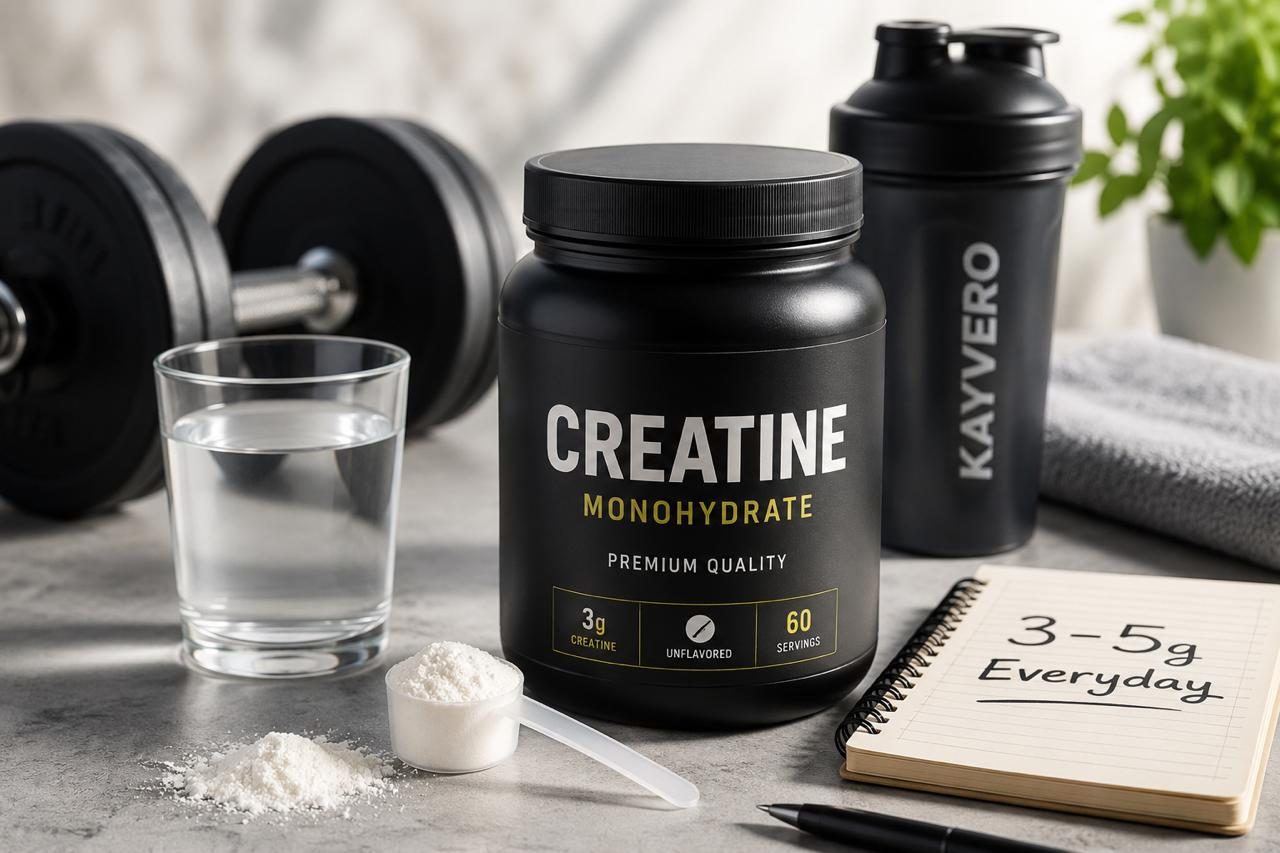
How to Take Creatine: Dosage, Timing, Loading Phase & Best Practices
Quick Summary
Creatine is one of the most effective and well-researched sports supplements available—but many people still wonder how to take it correctly.
Should you take it before or after a workout? Do you need a loading phase? Is 5 grams enough? Should you take it on rest days?
The good news is that the science is surprisingly simple.
For most healthy adults, taking 3–5 grams of creatine monohydrate every day is enough to maximize muscle creatine stores and support long-term improvements in strength, power, and exercise performance.
In this guide, you'll learn:
- The ideal daily creatine dosage
- Whether a loading phase is necessary
- The best time of day to take creatine
- How to take creatine on rest days
- Common mistakes to avoid
- Evidence-based recommendations backed by sports nutrition research
If you're new to creatine, we recommend reading "What Is Creatine? A Complete Beginner's Guide" first to understand how creatine works before learning the best way to use it.
Introduction
Learning how to take creatine doesn't have to be complicated.
Unfortunately, social media, supplement marketing, and gym myths often make it seem much more confusing than it really is.
You may have heard that creatine only works if you take it immediately after your workout.
Others claim you need to "load" it for a week.
Some recommend cycling it every few months.
Others suggest taking double doses on training days.
Most of these recommendations aren't supported by the strongest scientific evidence.
In reality, creatine works by gradually increasing the amount stored inside your muscles. That means your daily consistency matters far more than the exact time you take it.
For most people, following a simple routine is enough to experience the full benefits of supplementation.
In this article, we'll explain exactly how to take creatine, when to take it, how much you need, and which common practices are worth following—and which ones you can safely ignore.
How Much Creatine Should You Take?
The first question most beginners ask is also the easiest to answer.
For the vast majority of healthy adults, the recommended daily intake is:
3–5 grams of creatine monohydrate per day.
This recommendation is supported by decades of research and is sufficient to fully saturate muscle creatine stores over time.
Once your muscles reach saturation, continuing with the same daily dose helps maintain those levels without requiring higher amounts.
Daily Creatine Recommendations
| Goal | Recommended Daily Intake |
|---|---|
| General fitness | 3 g |
| Strength & muscle building | 3–5 g |
| Larger athletes (90 kg+) | 5 g |
| Maintenance after loading | 3–5 g |
Most people do not need more than 5 grams per day.
Taking larger amounts does not increase muscle creatine stores beyond their natural limit. Excess creatine is simply eliminated by the body.
If you're unsure whether your body size or training volume requires any adjustment, our Creatine Calculator can help estimate an appropriate daily intake based on your profile.
Why 3–5 Grams Works
Your muscles have a limited capacity to store creatine.
Once those stores are full, taking additional creatine does not produce greater performance benefits.
Think of it like filling a water bottle.
Once it's full, pouring in more water doesn't increase its capacity—it simply overflows.
The same principle applies to creatine.
A consistent daily dose is enough to keep your muscles fully supplied without unnecessary supplementation.
Fun Fact
💡 Most research showing positive results for creatine supplementation uses creatine monohydrate at approximately 3–5 grams per day, making it the most studied dosage protocol in sports nutrition.
Do You Need a Loading Phase?
One of the biggest misconceptions about creatine is that you must complete a loading phase before it starts working.
The truth is much simpler:
A loading phase is completely optional.
There are two evidence-based ways to supplement with creatine, and both ultimately produce the same result.
The only difference is how quickly your muscles become saturated.
Option 1: With a Loading Phase
A traditional loading protocol consists of:
- 20 grams of creatine per day
- Divided into four 5-gram servings
- Continued for 5–7 days
After that, intake is reduced to a maintenance dose of:
- 3–5 grams per day
The advantage is speed.
Muscle creatine stores become saturated within about one week.
This approach may be useful for athletes who want to maximize performance before an upcoming competition or training block.
Option 2: Without a Loading Phase
The second—and increasingly popular—approach is simply taking:
- 3–5 grams once daily
With this strategy, muscle creatine stores gradually increase over approximately 3–4 weeks.
Although it takes a little longer, research consistently shows that long-term muscle saturation is essentially identical.
For most people, this simpler approach is easier to follow and causes fewer digestive complaints.
Which Method Is Better?
For most beginners, daily supplementation without loading is the easiest and most practical option.
Here's a quick comparison:
| Loading Phase | Daily Dose Only |
|---|---|
| Faster saturation | Slower saturation |
| Results in about one week | Results in about one month |
| Higher daily intake | Lower daily intake |
| Greater chance of stomach discomfort | Better tolerated |
No matter which strategy you choose, consistency remains the most important factor.
Best Time to Take Creatine
Another common question is:
"When should I take creatine?"
The short answer is:
Whenever you'll remember to take it consistently.
Unlike caffeine or stimulant-based pre-workouts, creatine does not produce immediate effects after a single serving.
Instead, it works by gradually increasing the amount stored inside your muscles over days and weeks.
Because of this, taking creatine every day is far more important than taking it at a specific hour.
Current research has not shown a meaningful performance difference between taking creatine:
- before training,
- after training,
- with breakfast,
- or before bed.
Choose the time that best fits your routine.
A habit you can maintain is far more valuable than chasing the "perfect" timing.
If you'd like a deeper look at the research comparing pre- and post-workout supplementation, we'll cover that in our dedicated article:
Best Time to Take Creatine: Before or After Your Workout?
Should You Take Creatine With Food?
Creatine can be taken:
- with water,
- mixed into a protein shake,
- alongside a meal,
- or even on an empty stomach.
Some studies suggest that combining creatine with carbohydrates and protein may slightly improve muscle uptake because insulin helps transport nutrients into cells.
However, for most healthy adults, this difference is relatively small and has little impact on long-term results.
The most important goal is simply reaching your daily intake.
If taking creatine with breakfast helps you remember it every morning, that's an excellent strategy.
If mixing it into your post-workout shake is more convenient, that's equally effective.
Consistency always beats perfect timing.
Fun Fact
🥤 Creatine monohydrate has no meaningful calories and mixes well with water, juice, milk, or protein shakes, making it one of the easiest supplements to include in a daily routine.
Should You Take Creatine on Rest Days?
Yes.
This is one of the most common mistakes beginners make.
Many people assume creatine should only be taken on workout days because it's associated with exercise performance.
However, creatine doesn't work like a pre-workout supplement.
Its purpose is to keep your muscles saturated with creatine, not to provide an immediate boost before training.
That means your muscles benefit from having consistently elevated creatine stores every day—not just when you exercise.
For this reason, you should continue taking your regular daily dose during:
- Rest days
- Weekends
- Deload weeks
- Vacations
- Travel days
Skipping doses on non-training days won't erase your progress overnight, but making it a habit can slow the process of maintaining fully saturated muscle stores.
A simple rule to remember is:
Take creatine every day, regardless of whether you train.
What Happens If You Miss a Day?
Don't worry.
Missing one serving of creatine is not a problem.
Unlike caffeine or other supplements that work immediately, creatine stays stored inside your muscles.
One missed dose won't suddenly reduce your performance or empty your creatine stores.
If you forget to take it:
- Resume your normal schedule the next day.
- Do not double your dose.
- Focus on staying consistent over weeks and months.
Long-term consistency is what matters most.
Should You Cycle Creatine?
Another long-standing myth is that creatine should be cycled.
A common recommendation you'll still find online is:
- 8 weeks on
- 4 weeks off
Current scientific evidence does not support this practice.
Healthy adults can safely take creatine continuously without reducing its effectiveness.
There is no evidence that cycling:
- Improves results
- Prevents your body from adapting
- Protects kidney function in healthy individuals
As long as creatine continues to support your training goals, there is generally no reason to stop taking it.
If you have concerns about long-term safety or specific medical conditions, be sure to read our companion article:
Creatine Side Effects: Myths vs. Scientific Evidence
Common Mistakes When Taking Creatine
Even though creatine is one of the simplest supplements to use, a few common mistakes can prevent people from getting the best results.
1. Taking It Inconsistently
The biggest mistake is forgetting doses.
Muscle saturation depends on regular intake over time.
Aim to make creatine part of your daily routine.
2. Expecting Immediate Results
Creatine isn't a stimulant.
You won't feel an instant surge of energy after taking your first serving.
Most people begin noticing improvements after several weeks of consistent use.
3. Taking More Than Necessary
More creatine does not mean better results.
Once your muscles are saturated, excess creatine is simply excreted.
Stick to the recommended maintenance dose unless advised otherwise by a qualified healthcare professional.
4. Choosing Marketing Over Evidence
The supplement industry promotes many forms of creatine, including:
- Creatine HCl
- Buffered creatine
- Liquid creatine
- Creatine gummies
While these products may sound appealing, creatine monohydrate remains the gold standard because it has by far the strongest scientific evidence supporting its effectiveness, safety, and affordability.
Myths vs. Facts
Myth
"You have to take creatine immediately after your workout."
Fact
Research shows that daily consistency is far more important than precise timing.
Myth
"A loading phase is required."
Fact
Loading is optional. Taking 3–5 grams daily eventually produces the same muscle saturation.
Myth
"You should stop taking creatine every few months."
Fact
There is no scientific evidence supporting routine cycling for healthy adults.
Myth
"Taking more than 5 grams daily builds muscle faster."
Fact
Once your muscles are saturated, higher doses provide no additional performance benefit.
Myth
"You only need creatine on training days."
Fact
Daily supplementation—including rest days—is the best way to maintain optimal muscle creatine stores.
Conclusion
Taking creatine correctly is much simpler than many people believe.
For most healthy adults, the evidence-based recommendation is straightforward:
- Take 3–5 grams of creatine monohydrate every day
- Stay consistent
- Continue taking it on rest days
- Don't worry about finding the "perfect" time of day
- Skip the loading phase unless you want faster saturation
These simple habits are enough to maximize muscle creatine stores and support long-term improvements in strength, power, and training performance.
Rather than searching for complicated protocols, focus on building a routine you can maintain for months—not just days.
Consistency will always have a greater impact than perfect timing.
Continue Learning
If you'd like to learn more about creatine, continue with these science-based guides:
- What Is Creatine? A Complete Beginner's Guide
- Creatine Benefits: What Science Really Says
- Creatine Side Effects: Myths vs. Scientific Evidence
Kayvero Tools
Personalize your supplementation and nutrition with these free Kayvero calculators:
- Creatine Calculator
- Water Intake Calculator
- Protein Calculator
- TDEE Calculator
Medical Disclaimer
This content is intended for educational purposes only and should not be considered medical advice.
Always consult a qualified healthcare professional before starting any dietary supplement, especially if you have a medical condition, are pregnant or breastfeeding, or take prescription medications.
Scientific References
- International Society of Sports Nutrition (ISSN)
- American College of Sports Medicine (ACSM)
- National Institutes of Health (NIH)
- PubMed
- European Food Safety Authority (EFSA)
- U.S. Food and Drug Administration (FDA)
Frequently asked questions
- How much creatine should I take each day?
Most healthy adults benefit from 3–5 grams of creatine monohydrate per day to maintain fully saturated muscle creatine stores.
- Do I need a loading phase?
No. A loading phase is optional. Taking 3–5 grams daily eventually achieves the same muscle saturation as loading, although it takes a few weeks longer.
- Should I take creatine before or after my workout?
Current research suggests that consistency is more important than timing. Taking creatine every day matters more than whether it is consumed before or after training.
- Can I take creatine on rest days?
Yes. Creatine should be taken every day, including rest days, to maintain optimal muscle creatine stores.
- Can I mix creatine with protein shakes?
Yes. Creatine mixes well with protein shakes, water, juice and most non-alcoholic beverages.
- What happens if I miss one day?
Missing a single day is not a problem. Resume your normal daily intake without doubling the next dose.
- Should I cycle creatine?
No. Scientific evidence does not support cycling creatine for healthy adults.
- What is the best type of creatine?
Creatine monohydrate remains the gold standard because it offers the strongest evidence for effectiveness, safety and value.
Continue learning
Related calculators
- Creatine calculatorLoading and maintenance doses by body weight.Open calculator
- water intake calculatorOpen calculator
- Protein calculatorHow much protein you need per day.Open calculator
- Meal plannerBuild meals with real nutrition data.Open calculator
- Calorie calculatorYour daily calorie target in seconds.Open calculator
- Macro calculatorSplit protein, carbs and fat for your goal.Open calculator
- Food databaseNutrition facts for thousands of foods.Open calculator
Recommended products


