Supplements
How Long Does Creatine Take to Work?
Most people begin noticing creatine's effects within 1–4 weeks, depending on whether they use a loading phase and how consistently they supplement. A loading phase can saturate muscle creatine stores in about 5–7 days. Without loading, simi
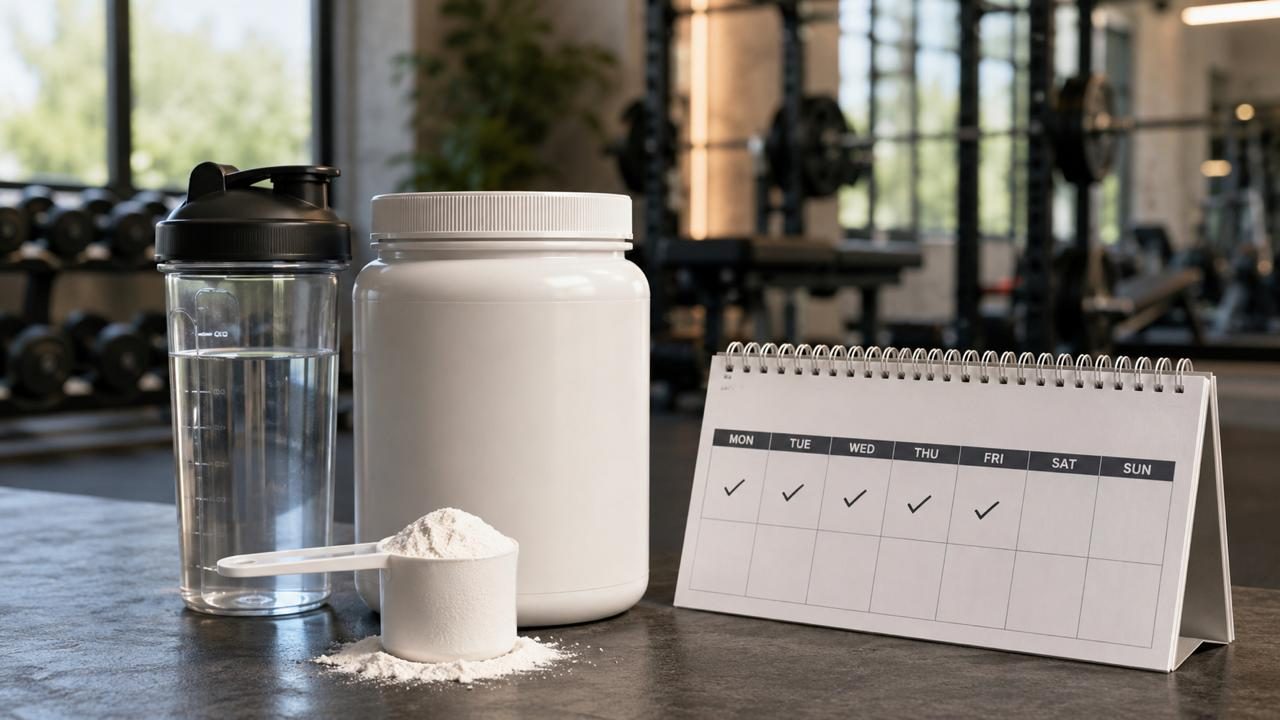
How Long Does Creatine Take to Work?
Quick Summary
- Most people begin noticing creatine's effects within 1–4 weeks, depending on whether they use a loading phase and how consistently they supplement.
- A loading phase can saturate muscle creatine stores in about 5–7 days.
- Without loading, similar muscle saturation usually occurs after 3–4 weeks of taking 3–5 grams daily.
- Creatine improves performance gradually by increasing muscle phosphocreatine stores—it does not produce an immediate stimulant effect.
- Consistency, progressive resistance training, adequate protein intake, and recovery have a much greater influence on results than trying to speed up the process.
Featured Snippet Box
| Question | Answer |
|---|---|
| How long does creatine take to work? | Usually 1–4 weeks. |
| With a loading phase? | About 5–7 days. |
| Without loading? | Around 3–4 weeks. |
| Does it work after one serving? | No. |
| Who may respond faster? | People with lower baseline creatine stores, including many vegetarians. |
| Biggest factor? | Daily consistency. |
Introduction
One of the first questions new users ask is, "How long does creatine take to work?"
The short answer is that creatine works gradually, not immediately. Unlike caffeine or pre-workout stimulants, creatine doesn't create an instant boost in energy after a single serving.
Instead, it increases the amount of creatine stored inside your muscles over time. As those stores become saturated, your muscles can regenerate ATP—the body's primary energy source for short, high-intensity exercise—more efficiently.
The exact timeline depends on several factors, including whether you use a loading phase, your daily dose, your baseline muscle creatine stores, your diet, and the consistency of your supplementation.
This guide explains the evidence-based timeline for creatine, what changes you can realistically expect during the first days and weeks, and why some people notice results sooner than others.
Does Creatine Work Immediately?
No. Creatine Needs Time to Build Up
Many sports supplements are designed to produce noticeable effects within minutes.
Creatine isn't one of them.
Rather than stimulating the nervous system, creatine gradually increases the amount of phosphocreatine stored inside skeletal muscle.
Those stores are used to rapidly regenerate ATP during repeated high-intensity activities like:
- Weight training
- Sprinting
- Jumping
- Team sports
- High-intensity interval training (HIIT)
Each daily serving contributes to building these reserves until your muscles approach saturation.
Once saturation occurs, performance improvements become more noticeable.
That's why creatine's benefits depend on consistent daily use, not on the timing of a single dose.
Best Practice: Think of creatine like charging a battery. Every daily serving adds a little more charge until your muscles are "fully charged."
How Long Does Creatine Take to Work?
The Typical Timeline
Research consistently shows that the timeline depends primarily on whether you complete a loading phase.
| Supplement Strategy | Typical Timeline |
|---|---|
| Loading phase | About 5–7 days |
| Standard daily dosing (3–5 g/day) | About 3–4 weeks |
| Strength improvements | Usually within several weeks |
| Muscle growth | Develops over weeks to months with resistance training |
These timelines are averages rather than guarantees.
Some people notice subtle improvements earlier, while others require several weeks before recognizing measurable differences.
The key factor isn't how quickly creatine "starts working"—it's how quickly your muscles become saturated with creatine.
Why Does a Loading Phase Work Faster?
It Increases Muscle Creatine Stores More Quickly
A loading phase dramatically increases creatine intake during the first week.
The most commonly studied protocol is:
- Approximately 20 grams per day
- Divided into four 5-gram servings
- Continued for 5–7 days
After loading, supplementation returns to a maintenance dose of 3–5 grams daily.
Because much more creatine is available during those first several days, muscles reach saturation much sooner.
Some users may therefore notice earlier:
- Improved workout performance
- Slight increases in body weight
- Fuller-looking muscles from additional intracellular water
However, loading does not improve the final outcome.
It only shortens the time needed to reach maximum muscle creatine stores.
Important: Loading is optional. Taking 3–5 grams daily without loading eventually produces similar muscle saturation—it simply takes longer.
What Happens Without a Loading Phase?
Results Come More Gradually
Many people choose to skip the loading phase altogether.
Instead, they simply take 3–5 grams of creatine monohydrate every day.
This approach increases muscle creatine stores more gradually, typically reaching near-saturation after three to four weeks of consistent supplementation.
Although the process takes longer, the long-term outcome is essentially the same.
Studies show that once muscle stores are saturated, people who skipped loading can experience similar improvements in strength, power, and exercise performance as those who completed a loading phase.
For many recreational exercisers, this slower approach is actually easier to maintain because it:
- Requires only one daily serving
- Reduces the chance of digestive discomfort
- Avoids taking multiple doses throughout the day
- Fits naturally into a long-term routine
The only trade-off is patience.
If your goal is long-term progress rather than immediate results, daily maintenance dosing is an evidence-based strategy that works well for most healthy adults.
Bottom Line: Loading gets you there faster, but daily maintenance reaches the same destination.
When Will You Actually Notice Results?
A Realistic Week-by-Week Timeline
Many people expect dramatic changes within a few days of starting creatine.
That's rarely how it works.
Instead, improvements usually appear gradually as muscle creatine stores increase.
| Timeline | What You May Notice |
|---|---|
| Days 1–3 | Usually no noticeable changes |
| Days 5–7 | Possible improvements if following a loading phase |
| Weeks 2–4 | Better training quality, fuller muscles, improved recovery between sets |
| Weeks 4–8 | More consistent improvements in strength and repeated high-intensity performance |
| Months | Greater long-term gains in lean muscle and training adaptations when combined with resistance exercise |
Not everyone follows this exact timeline.
Factors such as training quality, nutrition, genetics, and baseline creatine stores all influence individual results.
Creatine also doesn't replace progressive overload or a well-designed exercise program.
Without consistent resistance training, improvements are likely to be much smaller.
Tip: Measure progress over several weeks instead of judging creatine after only a few workouts.
Why Do Some People Notice Results Faster?
Individual Response Varies
Two people can take the same amount of creatine every day and still experience different timelines.
That's because several factors influence how quickly muscle creatine stores increase.
These include:
- Baseline muscle creatine levels
- Training frequency
- Muscle mass
- Daily consistency
- Diet
- Individual physiology
People who naturally have lower creatine stores often experience the largest response.
For example, vegetarians and vegans generally consume less dietary creatine because the nutrient is found primarily in animal foods.
As a result, supplementation may produce a more noticeable increase in muscle creatine stores.
Someone who already eats large amounts of meat and fish may still benefit from supplementation, but the change may be slightly less dramatic.
Age, muscle size, and training status can also influence how quickly improvements become noticeable.
Did You Know? About 95% of the body's creatine is stored in skeletal muscle, where it helps regenerate ATP during short, intense bursts of exercise.
What Changes Should You Expect First?
Performance Improves Before Muscle Size
One of the biggest misconceptions about creatine is that it immediately builds visible muscle.
In reality, the earliest benefits are usually improvements in exercise performance rather than changes in appearance.
Many people first notice:
- Completing one or two extra repetitions
- Feeling stronger during later sets
- Recovering faster between repeated efforts
- Maintaining power throughout a workout
These changes can make training sessions more productive.
Over time, consistently performing more high-quality work in the gym may contribute to greater gains in muscle mass and strength.
Some people also notice a small increase in body weight during the first week, especially after a loading phase.
This is usually caused by additional water stored inside muscle cells, not by body fat.
Visible muscle growth develops much more slowly and depends on progressive resistance training, adequate protein intake, total calorie intake, sleep, and recovery.
Important: Creatine supports muscle growth by improving training quality over time. It does not directly build muscle without exercise.
What If You Don't Notice Anything?
Lack of Immediate Results Doesn't Mean Creatine Isn't Working
Not everyone feels a dramatic difference after starting creatine.
That doesn't necessarily mean the supplement isn't effective.
Several factors can make results less noticeable, including:
- Inconsistent supplementation
- Recently starting creatine
- Limited resistance training
- Already having relatively high muscle creatine stores
- Expecting stimulant-like effects
Unlike caffeine, creatine produces gradual physiological changes.
Many benefits become apparent only after comparing training performance over several weeks.
If you've been taking 3–5 grams daily for at least three to four weeks, training consistently, and still notice no meaningful improvement, review your overall training program, nutrition, and recovery before assuming creatine is ineffective.
Individual responses vary, and some people naturally experience smaller improvements than others.
Can You Make Creatine Work Faster?
Focus on the Factors That Actually Matter
Although you can't force creatine to work instantly, you can maximize its effectiveness by following evidence-based habits.
The best approach is to:
- Take an appropriate daily dose.
- Consider an optional loading phase if faster saturation is important.
- Take creatine every day, including rest days.
- Follow a progressive resistance-training program.
- Consume enough protein and calories to support your goals.
- Prioritize sleep and recovery.
Taking more creatine than recommended won't speed up long-term results.
Very large doses are more likely to increase digestive discomfort than improve performance.
Likewise, doubling your dose after forgetting a serving won't compensate for the missed day.
Best Practice: Consistency is far more important than perfection. A simple routine you can maintain for months will always outperform an inconsistent "optimal" strategy.
Common Mistakes That Delay Results
Several common mistakes can make creatine appear less effective than it really is.
These include:
- Taking creatine only on workout days
- Frequently missing daily doses
- Expecting immediate effects
- Training without progressive overload
- Eating too little protein or total energy
- Stopping supplementation after only a few days
Creatine works best when it's combined with an effective training program and a balanced diet.
It should be viewed as one tool that supports long-term progress—not as a shortcut that replaces consistent exercise and recovery.
Fun Fact
Researchers estimate that the average adult stores about 120–140 grams of creatine, with approximately 95% located inside skeletal muscle. Supplementation works by increasing these natural stores, allowing muscles to regenerate energy more efficiently during repeated high-intensity exercise.
Myths vs. Facts
Myth
Creatine works after the first serving.
Fact
Creatine's benefits depend on gradually increasing muscle creatine stores. Most people need consistent daily supplementation for one to four weeks before noticing meaningful effects.
Myth
A loading phase is required.
Fact
Loading speeds up muscle saturation, but it isn't necessary. Taking 3–5 grams daily without loading reaches similar muscle creatine levels over several weeks.
Myth
Taking more creatine makes it work faster.
Fact
Once muscle creatine stores are saturated, larger doses don't produce greater long-term benefits and are more likely to cause digestive discomfort.
Myth
If you don't feel anything, creatine isn't working.
Fact
Many of creatine's benefits are gradual. Improved workout performance often appears before obvious changes in muscle size.
Myth
Creatine builds muscle without exercise.
Fact
Creatine supports resistance training by improving energy availability during high-intensity exercise. Muscle growth still depends on consistent training, nutrition, and recovery.
Myth
Missing one day ruins your progress.
Fact
Muscle creatine stores decline gradually. Missing a single dose has little practical impact—simply resume your normal supplementation schedule.
Key Takeaways
- Most people notice creatine's effects within one to four weeks.
- A loading phase can shorten this timeline to about five to seven days.
- Standard daily supplementation reaches similar muscle saturation after approximately three to four weeks.
- Creatine improves performance by increasing muscle phosphocreatine stores rather than acting as a stimulant.
- Daily consistency is far more important than taking creatine at a precise time.
- Performance improvements often appear before visible muscle growth.
- Long-term results depend on combining creatine with progressive resistance training, adequate nutrition, and recovery.
Conclusion
How long does creatine take to work?
For most healthy adults, noticeable benefits develop within one to four weeks of consistent supplementation. A loading phase can shorten this timeline by increasing muscle creatine stores more quickly, but it's not required to achieve the same long-term results.
Creatine doesn't produce an immediate boost after a single serving. Instead, it works by gradually increasing muscle phosphocreatine stores, allowing your body to regenerate energy more efficiently during repeated high-intensity exercise.
If your goal is to maximize results, focus on consistency rather than speed. Taking an evidence-based daily dose, following a structured resistance-training program, eating enough protein, and allowing adequate recovery will have a much greater impact than searching for shortcuts.
For a deeper look at whether loading is worth it for your goals, continue with Creatine Loading Phase: Is It Really Necessary?
Continue Learning
- What Is Creatine? A Complete Beginner's Guide
- How to Take Creatine: Dosage, Timing & Best Practices
- Creatine Loading Phase: Is It Really Necessary?
- Best Time to Take Creatine: Before or After a Workout?
- How Much Creatine Should You Take Per Day?
Kayvero Tools
- Creatine Calculator
- Protein Calculator
- Water Intake Calculator
Medical Disclaimer
This article is for educational purposes only and should not replace personalized medical advice. Consult a qualified healthcare professional before starting creatine supplementation if you have a medical condition, take prescription medications, are pregnant or breastfeeding, or have concerns about kidney health.
Scientific References
Kreider RB, Kalman DS, Antonio J, et al. International Society of Sports Nutrition Position Stand: Safety and Efficacy of Creatine Supplementation in Exercise, Sport, and Medicine. Journal of the International Society of Sports Nutrition.
Antonio J, Candow DG, Forbes SC, et al. Common Questions and Misconceptions About Creatine Supplementation: What Does the Scientific Evidence Really Show? Journal of the International Society of Sports Nutrition.
Candow DG, Forbes SC, Chilibeck PD, et al. Variables Influencing the Effectiveness of Creatine Supplementation. Frontiers in Nutrition.
National Institutes of Health. Dietary Supplements for Exercise and Athletic Performance.
European Food Safety Authority. Scientific Opinion on Creatine and High-Intensity Exercise Performance.
International Olympic Committee. Consensus Statement on Dietary Supplements and the High-Performance Athlete.
Frequently asked questions
- How long does creatine take to work?
Most people notice creatine's effects within one to four weeks. A loading phase can saturate muscle creatine stores in about five to seven days, while standard daily dosing usually takes three to four weeks.
- Does creatine work after one dose?
No. Creatine does not produce an immediate effect like caffeine. Its benefits depend on gradually increasing muscle creatine stores through consistent daily supplementation.
- Does a loading phase make creatine work faster?
Yes. A loading phase increases muscle creatine stores more quickly, allowing some people to notice performance-related effects within approximately one week.
- When will I notice results from creatine?
Many people first notice fuller muscles or improved performance during repeated high-intensity exercise within one to four weeks. Visible muscle growth takes longer and depends on consistent resistance training.
- Why isn't creatine working for me?
Inconsistent dosing, insufficient time, limited training stimulus or naturally high baseline muscle creatine stores can make the effects less noticeable. Evaluate results after at least three to four weeks of consistent use.
- Does creatine work on rest days?
Creatine remains stored in muscle on rest days. Taking your regular daily dose on both training and rest days helps build and maintain elevated muscle creatine stores.
- Can diet affect how quickly creatine works?
Yes. People who consume little dietary creatine, including many vegetarians and vegans, may have lower baseline stores and sometimes experience a more noticeable response to supplementation.
- How can I make creatine work faster?
An optional loading phase is the fastest evidence-based way to increase muscle creatine stores. Consistent dosing, resistance training, adequate nutrition and sufficient recovery remain essential for meaningful results.
Continue learning
- How to Take Creatine: Dosage, Timing & Best PracticesCreatine is one of the most effective and wellresearched sports supplements available—but many people still wonder how to take it correctly.Read article
- Creatine Benefits: What Science Really SaysCreatine is one of the most extensively researched sports supplements available.Read article
- Best Time to Take Creatine: Before or After a Workout?The best time to take creatine is the time you can follow consistently every day.Read article
- Creatine Side Effects: What Science Really SaysCreatine monohydrate is generally considered safe and well tolerated for healthy adults when used at recommended doses.Read article
Related calculators
- Creatine CalculatorOpen calculator
- Protein CalculatorOpen calculator
- Water Intake CalculatorOpen calculator
- Calorie calculatorYour daily calorie target in seconds.Open calculator
- Macro calculatorSplit protein, carbs and fat for your goal.Open calculator
- Meal plannerBuild meals with real nutrition data.Open calculator
- Food databaseNutrition facts for thousands of foods.Open calculator
Recommended products


